

Pomegranate Seeds in Summer
by Leila Lois
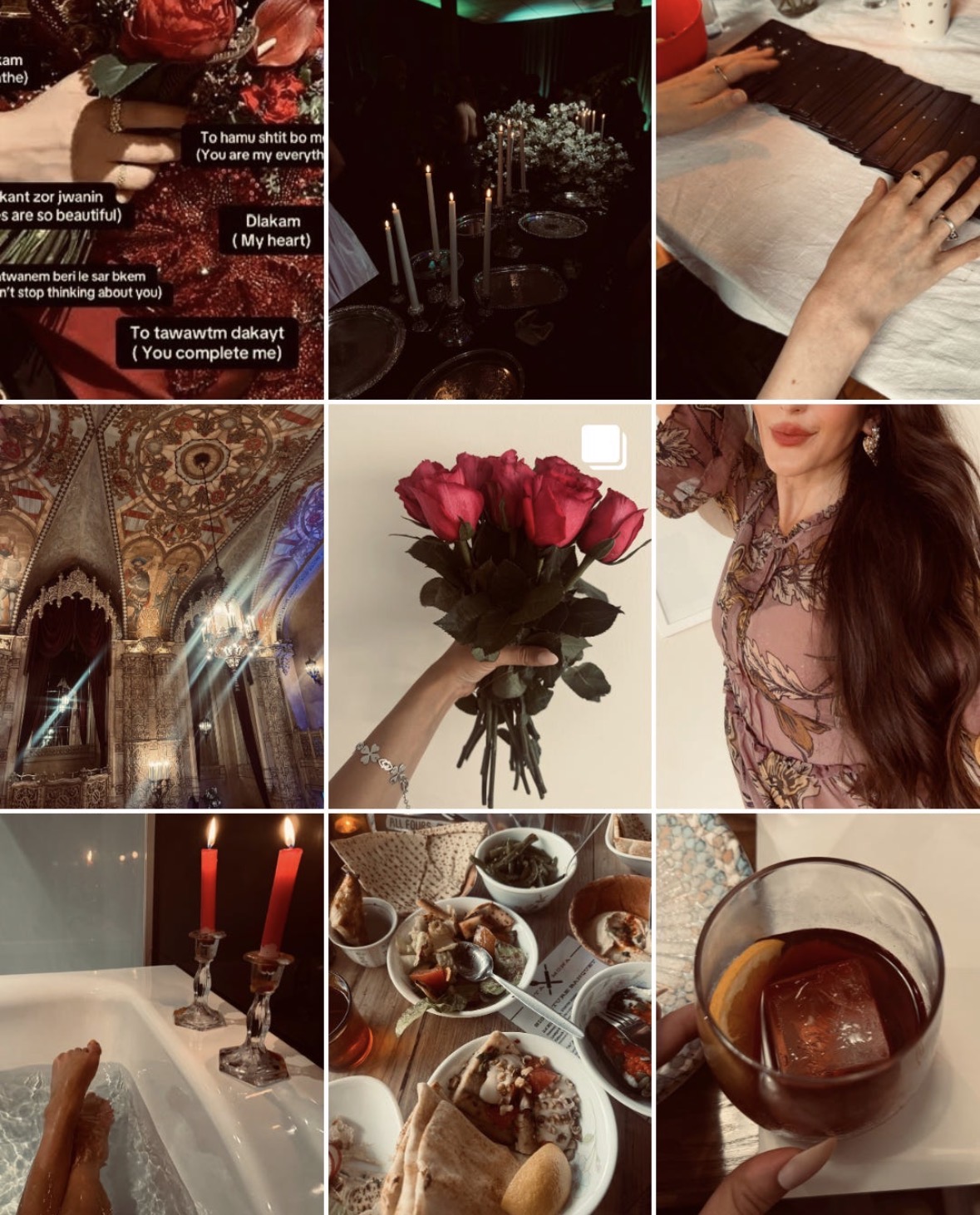
On Yalda night, I lit a candle for my beloved. We may never see each other again, we may never speak, but that doesn't change the sentiment. Once beloved, one doesn't become un-beloved. As thick and sweet, the beloved sticks to the chambers of the heart like pomegranate molasses in a glass bottle.
The flame trembled in my apartment as summer heat pressed against the windows. Outside, jacarandas shed their vividly purple bloom onto suburban streets, the flowers crushed into violet paste on the footpath, staining the concrete like spilled wine. But inside I conjured winter—the longest night of the year as my grandmother knew it.
I had laid out the ritual that afternoon before leaving for my night shift. Pomegranates split open like jewelled lockets, their seeds catching the light; rubies scattered across a white plate. Watermelon, improbable in this season here, sweet and cool, spread like a tarot deck, one slice on top of the other. Dried fruits and nuts in small bowls, figs dark as secrets, almonds like teardrops, pistachios the color of spring we were willing into being.
Callum, taking one look at my Yalda spread, laughed, "It's like a harvest festival," he'd said, those blue eyes bright with curiosity, and, brushing soft hair from his temples, added: "but backwards. You're celebrating in the dark to bring back the light."
"Yes," I'd told him, surprised he understood so quickly. "We stay awake through the longest night. We read poetry. We eat summer ripened fruits to remind us that winter cannot last forever."
He had picked up a pomegranate seed with his tattooed hand, those Celtic knots sinewing around his knuckles and wrist, ancient symbols that made my father smile sadly and say, "Derya, he carries his history on his skin, like we carry ours in our tongues."
I watched his fingers. I was always watching his fingers– the way they held the small seed with surprising delicacy, a gentleness that undid me every time. He held it to the candlelight, and the red glowed through it like a coal.
"Like swallowing stars," he murmured, and then he looked at me, not the seed, and placed it on my tongue instead of his own. The gesture was so quiet, so deliberate, that I felt it somewhere below my ribs. He touched strange and sacred things with those hands that already knew, without being told, exactly where to linger.
Tonight the pomegranate seeds were stark against the white ceramic. I held a few in my newly illustrated hand, deq markings tracing my hand, moons and stars.
This was my first Yalda without my father. There was no funeral for us to attend, just phone calls in the middle of the night and my grandmother's wailing, and the terrible knowledge that he was being cremated, not buried, which was haram to her. And that we said goodbye to a photograph instead of a face.
I thought of Callum's tattooed hands, moons dark against his skin, cracking open the tough pomegranate skin, teaching me an easier way than my grandmother's method. I thought of his laugh when the juice stained his fingers crimson, mixing with the ink. I thought of how I had called him from the airport, barely able to speak, and he had said "I'm coming" without hesitation. But there was nowhere to come to. No funeral. No grave to stand beside. Just an ocean between me and my father's body, and Callum's voice on the phone saying "I'm here, I'm here" when he wasn't, when he couldn't be, when nobody could be. "You've made me a murderer of fruits," he'd said last Yalda, kissing my temple. Six months before my world broke open.
The poetry lay open beside the candles. This year, the book stayed silent. I couldn't bear to hear the words without him. I traced my fingers over the script I could barely read, remembering how Callum would lean close, his leather jacket creaking softly, asking about the stories. Tales of love and loss, of fathers and sons, of kingdoms built and destroyed.
"Your history is so long," he had whispered once. We were walking through the NGV's permanent collection, past paintings of European kings in gilt frames, and he'd said, "My family's been in Australia for five generations and we think that's ancient. But you—you carry thousands of years."
“It’s like that with your tales, Merlin, Sir Gawain and the Green Knight,” I said, as we passed the Edward Burne-Jones studies, light, mystical renderings of faery-like women, their hair carrying the briar wood winds.
Callum had seen something beautiful in what I thought was broken. He learned to say "Yalda pîroz bê". He learned to love Diet Coke with souvlaki from that place on Brunswick Street, the one with the fluorescent lights and plastic chairs, where the owner knew my order before I opened my mouth. He didn't, like my previous boyfriend, exclaim "as IF," the first time I asked him if he wanted a Diet Coke too.
When Dad died, Callum had wanted to come to me, but there was no ceremony to attend, no place to go. I held my own vigil in the living room of my apartment. Listening to Graceland and watching tulips collapse slowly in a vase, their stems bending like broken necks. He had texted: I want to be there. Let me be there. But I was too broken.
But he had come anyway. Not to the apartment, he understood that much. He'd waited in his car outside, his leather jacket collar turned up against the autumn chill, and when I finally emerged at two in the morning, unable to sleep, needing air, needing escape, he was there. He didn't say anything, just opened the passenger door. We drove to St. Kilda beach and sat watching the black water roll in, the pier lights smeared across the bay and he held my hand with his fingers wrapped around mine, those Celtic knots pressed against my pulse, and that was enough. That was everything.
The candle guttered in a draft, and I cupped my hand around it protectively. In Kurdish tradition, the flame must not go out before dawn. Light must survive the darkness.
My phone sat beside the pomegranates, its screen dark and silent. I had written and deleted a dozen messages over the past weeks. After my father's death, I had pulled away, not because I wanted to, but because grief made me feel like I was drowning, and I didn't know how to let someone witness that. Because my grandmother needed me. She would call me crying about dreams where she’d see him and they’d finally see each other, for the first time, putting their legacy of pain aside. I had my own dreams. Where my father was behind a one way vision glass, I was gesturing to him but he was oblivious. Or we were in a cavernous theatre, in opposite boxes, I couldn’t catch his eyes. I could hardly explain how it made me feel. Because guilt and loss tangled into something too complicated to explain.
But Callum had never really left. He'd texted, gently. Called sometimes, just to say he was thinking of me. Left a book of Hafez translations on my doorstep with a note that said only: For the longest night. He understood something about patience, about love that waits. He also got very angry a few times when I was in the fray. It was okay. I was lost at sea.
I thought about calling him. His number still in my phone, his contact photo still that image I'd taken at the Arts Centre, his deep blue eyes catching the afterglow of the ballet. I always went to the ballet with my father as a teen, before. And then alone. The last time, I'd sat in the dark watching Swan Lake and felt my father's absence. Outside afterward, the city lights reflected in the Yarra, turning the brown water into liquid bronze, and I'd walked home along Southbank thinking about all the things we'd never do together again.
I broke open another pomegranate, my grandmother's way, splitting it in water so the bitter white pith floated and the seeds sank like small red fish. Each seed is a wish. Each seed is a memory. Callum and I at the NGV, standing in front of Fred Williams' You Yangs paintings, me asking why the trees looked like that, him trying to explain eucalyptus, how they shed their bark instead of leaves, how they're built for fire and drought and survival. Callum read Hafez aloud, stumbling beautifully over the transliteration. Callum defended a refugee writer at his work party when someone made a casual joke about "boat people," his voice going cold and sharp as a blade.
"The beloved sticks to the chambers of the heart," my grandmother used to say. She had lost my grandfather, his mind before his body. She never forgot him. On Yalda, she would light an extra candle, never saying for whom.
Now I understand. Love doesn't evaporate with distance or circumstance. It crystallises, becomes something harder and more permanent than mere happiness. The pomegranate seed you swallow becomes part of you, they say. Persephone ate six and was bound to the underworld for six months of every year. I had swallowed hundreds with Callum, laughing as the juice ran down our chins. I don't care if I'm exiled for half the year. If I can spend six months with him, I'm blessed.
Outside my window, Melbourne sprawled under the summer stars. The jacaranda trees made violet tunnels of the side streets. Somewhere in Fitzroy, Brunswick Street would be alive with people spilling out of bars, kebab shops, the smell of grilled meat and cigarette smoke mixing with jasmine from somebody's overgrown front garden. The city hummed with a particular kind of loneliness—thousands of people, none of them the one you wanted. I had been listening to the same song—
“I'm in another body
Whose in somebody else
Both of the headless and heartless
Dancing with themselves”
the strawberries and cherries of summer ripe with promise, I watched bubbles rise in my glass.
But here, in this pocket of Kurdish time, it was the solstice. The longest night. The moment when everything balances on darkness, when light is just a promise, when you have to believe that dawn will come even though you cannot yet see it.
The refrain—
Why me. Why you.
“I only really want you
Are you holding on?
Don't you wanna get a move on?”
I picked up my phone. My fingers hovered over his name for a long moment, and then I typed: Happy Yalda. Are you awake? Can I call you?
The reply came within seconds, just three words: Please do. Waiting.
My heart stumbled. I pressed call, and he answered before the first ring finished.
"Hey," he said, and his voice was everything—warm and careful and full of something that sounded like relief.
"Hey," I whispered back. "I'm sorry I've been—"
"Don't," he interrupted gently. "You don't have to apologise for grief."
I closed my eyes, tears finally coming after months of holding them back. "I have pomegranates," I said, which was a ridiculous thing to say, but somehow he understood.
"Save me some seeds," he said. "I'm getting in the car."
"Callum, it's midnight."
"It's the longest night," he said, and I could hear his leather jacket rustling as he moved, could picture him grabbing his keys. "You're supposed to stay awake until dawn, right? Someone should keep vigil with you. Someone should be there."
Through the phone, I heard his car start. "Read me some Hafez while I drive," he said. "Your father would want you to read the poetry."
So I did. I read Hafez in my clumsy transliteration while Callum drove through the summer night, probably down Punt Road with its river of red tail lights, past the Botanical Gardens dark and rustling with wide-eyed possums, through the city where Crown's flames shot into the sky on the hour like clockwork dragons. When I stumbled over the words, he'd repeat them back to me, his Australian accent mangling the Feyli beautifully, and I laughed through my tears.
Twenty minutes later, I heard his footsteps on the stairs. The candles trembled. I opened the door before he could knock.
He stood there, his eyes a flash of blue, finding mine, his tattooed hands holding a single pink pomegranate like an offering. His shirt smelled like night air and petrol stations. "I stopped at the all-night grocer," he said. "Thought you might be running low."
I pulled him inside, into the candlelight, into the longest night.
We sat together on the floor, the book open between us, and I told him about my father… told him all the things I'd been holding back. About how Dad had loved Callum's questions, how he'd said once, "That boy listens like he's trying to learn the whole world." About how I regretted that Dad had died so far away.
Callum listened, his hand holding mine, and when I finished, he said, "Tell me the stories. The ones your father read. I'll learn them, and we'll read them together every Yalda. His voice doesn't have to be lost."
So we read. We ate pomegranate seeds until our fingers were stained red, until the tartness and sweetness mixed on our tongues, I licked the tart juice from his index finger. Callum pulled me against his chest, and I listened to his heartbeat, steady as a promise.
"The beloved sticks to the chambers of the heart," I whispered against his ear.
"Like pomegranate molasses," he murmured into my hair. "Thick and sweet and permanent."
We kept the candles burning through the night, watching the flames dance, watching the darkness slowly surrender. In the stirring, Melbourne's summer dawn came early—magpies started their warbling at four-thirty, kookaburras followed. The sky turned from black to indigo to that particular pale gold that only happens in Australian summer, the light different from anywhere else in the world, sharp and clean and unforgiving.
When it finally touched my windows, painting Callum's face in that fierce gold, his eyes bright and sleepless and full of something that looked like devotion, I understood what my grandmother had known all along.
The longest night is not about enduring darkness alone. It's about keeping vigil together. It's about believing that light will return, and having someone beside you who believes it too.
"Yalda pîroz bê," Callum said softly, brushing a strand of hair from my face, his Celtic knots tracing across my cheek.
"Yalda pîroz bê," I whispered back. And then, because it felt right, because my father would have wanted this, because love doesn't require permission: "Welcome to the return of the light."
Outside, we were waking to another summer day. Sprinklers would start soon in the suburban gardens, the wattle would be swept from the gutters, the city would fill with the particular sound of trams on tracks, of magpies and construction and life continuing.
Callum's hand was warm in mine. The candles had burned down to pools of wax, white puddles with blackened wicks.
"I should probably go," he said, but didn't move.
We sat there as the room filled with pale gold light, neither of us speaking, neither of us leaving. My grandmother's Shahnameh lay closed on the floor, its pages holding stories of fathers and sons, of kingdoms that rose and fell like laboured breath. Tomorrow I would call her, tell her I'd kept the vigil, that the flame never went out.
The beloved sticks to the chambers of the heart, thick and sweet as pomegranate molasses. My grandmother was right about that. But she never mentioned what happens after the longest night ends. She never said whether Persephone was glad when spring came, or whether she mourned the underworld in summer, missed the dark and the quiet and the weight of the earth above her head.
Outside, the magpies were singing. The jacarandas would bloom again next year, purple and extravagant and brief. There would be blistering hot days and cool changes and dirty rain. And somewhere in the mountains my grandmother fled from, the sun was setting on another Yalda, other candles being lit, other vigils beginning.
*Yalda is the winter solstice in the Kurdish calendar. Candles are lit for the darkest night, love and hope for dawn is observed.

Leila Lois is a writer and dancer of Kurdish-Celtic origin based in Melbourne, Australia. She has poetry, essays and short stories published internationally for publications including LA Review of Books, Honey Literary Journal and Cordite. She is also published in several anthologies, most recently Sleeping in the Courtyard: Kurdish Writers in Diaspora, edited by Holly Mason Badra and published by University of Arkansas Press and the upcoming Body of Work: Essays on Dance.


Comments