

Would You Like to See My Fairytale Book Collection?
We can't all afford a first edition of Perrault's Histoires ou contes du temps passé, but is it worth looking at old, sometimes even smelly, fairy-tale books?
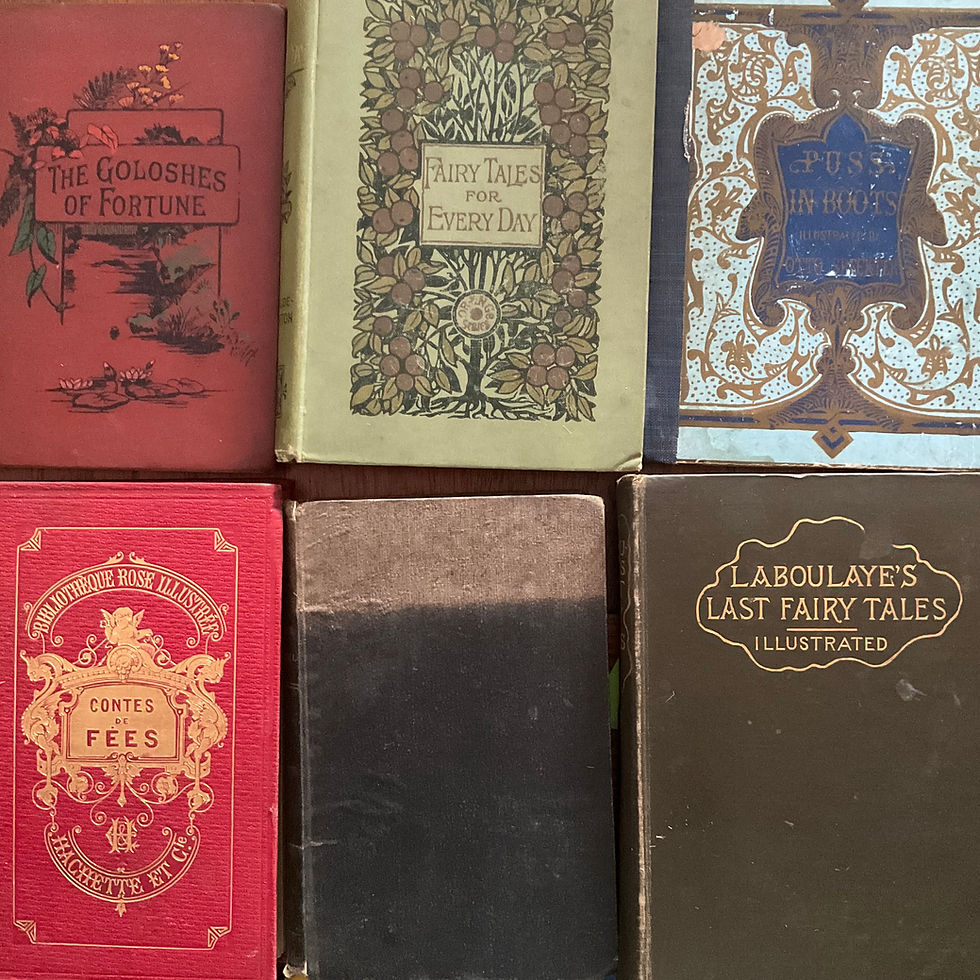
My mother and I spend the year searching for really old books to gift each other at Christmas - if we can manage to hide them before the other one sneaks them to their night table. We prefer books a hundred or more years old. Gilded covers are excellent. These are books that are crafted to be read, long before we started obsessing about 'content.' To paraphrase Rupert Giles in Buffy the Vampire Slayer, books have a musty odour, a richness, while words on screen haven't any texture or context. The stories, the histories in books have context and weight, snuggling between the covers waiting for us to discover them.
Old books are beautiful productions in their own right and you go back far enough and the illustrations are absolutely amazing - and often crackers. Why don't more books today have such illustrations? In a culture slowly being subsumed by AI, the art of old books reminds us that the material book itself is a thing of delight, well beyond its words. The smell of centuries, the feel of the old paper under our fingers, the indent of print, the care put into the gilding of the cover, the still-glossy plates with coloured pictures, the incidental marginalia and book plates. You can't really curl up to a device of aluminium, glass, plastic, silicon, and lithium. You absolutely can curl up to a book and its long history. Such books may have passed through other hands before ours, making us jealous of those whose fingers first danced among the crisp pages; they may have been ours from childhood, reminding us of the thrill as we first scoured the printed words; they may have been a gift, the scrawl of the giver reminding us of a special occasion and, occasionally, perplexing us with their intent.
During my time studying fairy tales, I've gathered up my share of old books. I liked to have my own copies to refer to and sometimes it really was impossible to access the tale unless I bought the book. When we study literature, we're often guided to specific editions that have carefully addressed the print history of the work. But for fairy tales, this print history becomes rather more fun. While we still seek the authority of a good translator or editor, who can parse the print history, their editions informed by the latest scholarship, sometimes it's just as fun to leap into the unknown and the harum scarum of fairy-tale publishing. From writing papers and games to pamphlets and chapbooks to bound, illustrated editions, this is an unreliable history of the fairy tale, as fraught with speculation, theft, and cheerful mimicry as the oral traditions. And that's kind of the point. Fairy tales do not have that many 'authoritative' versions. The lack of authority is just as interesting - the random reprints, tales lacking provenance, mistaken attribution. Marie-Jeanne L'Héritier's tale of the cunning princess, Finette, was sometimes attributed to her venerable, stodgier relation, Perrault, particularly in the eighteenth and nineteenth centuries, even though L'Héritier's work was far longer, far more detailed, far more uniquely her own. Ironically, Ruth Bottigheimer and Sophie Raynard posit that the inclusion of "The Discreet Princess" in Perrault's collection was likely why his collection did sell well at first. Once it was gone, his fare was readily sold as children's literature. The female authors of fairy tale weren't writing for children. Yet the publication history of fairy tale is very much about pursuing the emerging audience of literate children and, more importantly, the relatives and friends who purchased their most suitable books. Earlier voices were silenced for the sake of the children.
Chasing fairy tales across languages, uncertain copyright, and editorial impunity is a game.
I admit, when I first joined a literary studies department, I was a little puzzled by the scholars who worked tirelessly to discover, confirm, and correct tiny bits of knowledge about forgotten works written centuries earlier, but soon I was fascinated. It's historical detective work, and through those tiny inspections of a printed word or an engraving, the larger world of the author and their publishers began to be seen. And the spread of literacy took physical form in the books produced.
Now, my grandmother's great grandmother, born in 1837, was illiterate, as were her parents. Most of the relatives on that side of the family were at that point. Penelope was the daughter of coal miners and I doubt she saw a school for more than the odd day. She was likely, unofficially, working in the mines with other girls and women. I've seen her cross on old documents. The books I've been collecting were largely published during her lifetime, but she would scarcely have had any use for them, though I don't see why she wouldn't have enjoyed them as beautiful objects. Nonetheless, she was the wife of a farm labourer, and while her children did go to school, they were out in the world by eleven or twelve to earn their own wages. The odd chapbook or reader may have made its way to them, or a piece from a magazine, but by and large, the beautiful volumes of fairy tale were never destined for their hands.
Collecting them now, I think there is a little bit of revenge involved. They're all ours now, on behalf of Penelope and Hannah and the others. And they are beautiful, aren't they? The illustrations are detailed in ways that we don't see today. My copy of Puss in Boots, illustrated by Otto Speckter, is one of my favourites. And it's not even in colour! But in the lines of those beautiful black and white stone engravings, Speckter takes me into the very rooms that Puss inhabits. It really is just as interesting watching how illustrators retell the stories. Speckter's Puss is large and masculine, almost as large as the donkey. He'd terrify a Maine Coon. This is a cat you take seriously. His back is arched as he sizes the younger son up. The younger son has an open pose and his head hangs low in despondency. He wears simple attire and low shoes. Poverty is suggested by that lonely peasant loaf. But just through the window, you see a man apparently holding a pair of boots. There is much to dwell upon.
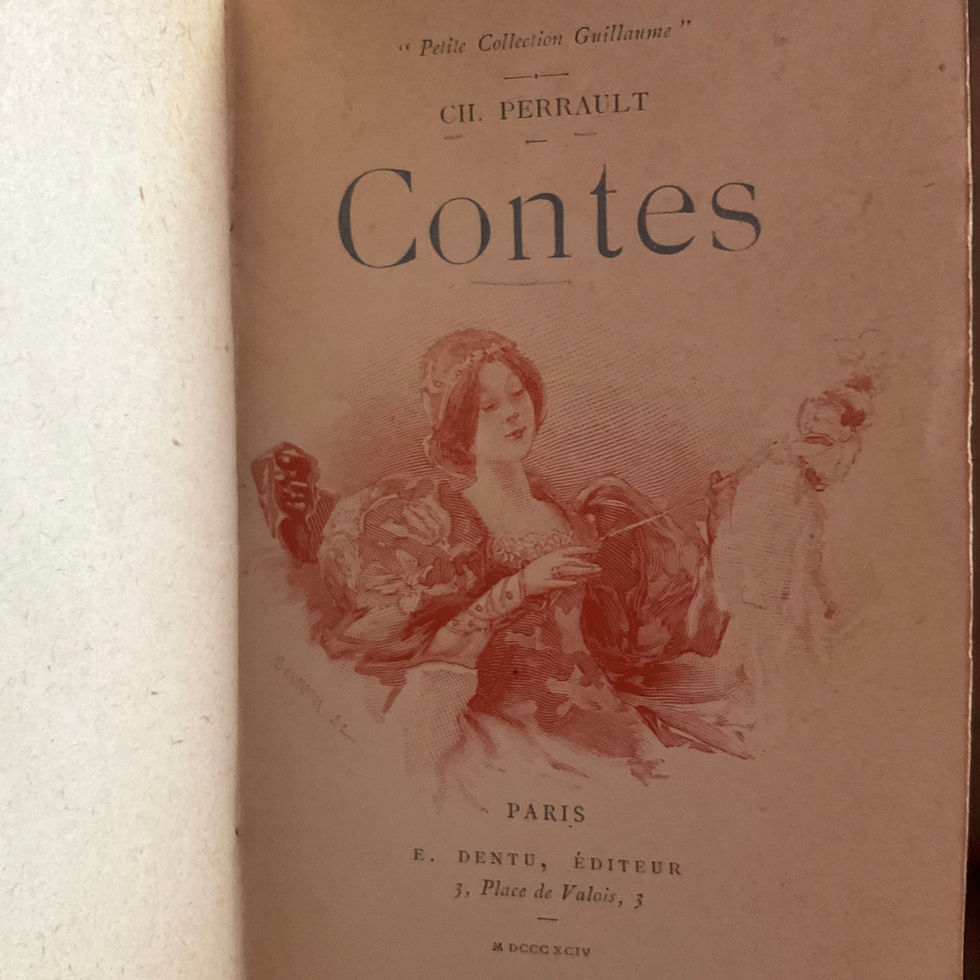
Then there's the frontispiece of Perrault and those magnificent puffed sleeves! Many a frontispiece gives you a fascinating insight into how the illustrators see the process of storytelling. In this case, this is not an elderly storyteller with her spinning wheel, but a beautiful young spinner. Likely also the Sleeping Beauty, but here on the frontispiece, she wields the distaff and spins her own tales. The old fairy-tale books also give us delightful insights into the owners, those who gifted the books or those who earned them as prizes for some long-forgotten feat. Wouldn't I love to see Nellie's scrap album! And some old books have their gorgeous art nouveau plates. The books hold histories beyond the printed word - the histories of the readers themselves.
Of course, in fairy tale, it would be remiss not to mention the coloured fairy books edited by Andrew Lang, although it has become increasingly apparent that his wife, Leonora Blanche Lang, along with a number of female translators, were the driving force and worked long and hard on the books, often without being explicitly named or reduced to plain 'Mrs.' or 'Miss.' Lang gives an account of the attribution in The Lilac Fairy Book of 1910:
In truth I never did write any fairy books in my life, except ‘Prince Prigio,’ ‘Prince Ricardo,’ and ‘Tales from a Fairy Court’—that of the aforesaid Prigio... The object of these confessions is not only that of advertising my own fairy books (which are not ‘out of print’; if your bookseller says so, the truth is not in him), but of giving credit where credit is due. The fairy books have been almost wholly the work of Mrs. Lang, who has translated and adapted them from the French, German, Portuguese, Italian, Spanish, Catalan, and other languages. My part has been that of Adam, according to Mark Twain, in the Garden of Eden. Eve worked, Adam superintended. I also superintend.
It is worth noting that here Lang spruiks his own, original fairy tales about a prince 'cursed' to be too clever, overt in his desire to advertise these. There is a casual acceptance that his role as superintendent of the work justifies his status in the production of the coloured fairy books, but that he himself is 'better' than the work. He is quick to infer that although people think he spends time on writing fairy books, he is far busier than that with loftier literary matters, and the reputation he has gained through the fairy books "is killing me."
Perhaps I am severe on Lang? Still, reading his introduction to The Brown Fairy Book is not for the faint hearted today - albeit, not the worst I've read: "‘The Bunyip’ is known to even more uneducated little ones, running about with no clothes at all in the bush, in Australia." The linking of Dreamtime and other Aboriginal stories to fairy tales can also be problematic, even early Aboriginal authors like David Unaipon tending to blur distinctions between traditional Aboriginal stories and European fairy tales, but that's a discussion for another day. The coloured books nonetheless dominated fairy-tale publishing for a long while. One of my favourite authors, Stella Gibbons, read them and mentions The Violet Fairy Book in one of her own novels, loosely inspired by "Beauty and the Beast," White Sand and Grey Sand. Tolkien's essay on fairy stores also notes: "In English none probably rival either the popularity, or the inclusiveness, or the general merits of the twelve books of twelve colours which we owe to Andrew Lang and to his wife." Tolkien, however, does have a few issues with what is included. Then, he is quite severe on what he feels should not be included in the scope of the fairy story!
Despite all this, and the rewriting of many tales contained within, the books themselves are a beautiful production and there's nothing quite like the tactile delight of touching those embossed, gilded covers. Likewise, the female-led re-tellings are a treat.
But I do have a soft spot for the odder collections, like Laura Valentine's, where she chaotically collects tales from everywhere. I'm still trying to find where she got her thoroughly amazing account of "Little Red Riding Hood," accredited to Perrault, and featuring the wolfhound Bran and Hugh and his fellow woodsmen and many other details that were never in Perrault. The story itself only exists in certain editions of The Old Old Fairy Tales, as the volume appears in different editions all over the world, lending to the general state of confusion. There's also an awesome tale, from the French, about the king of Zinzolantines "who had an extreme passion for silk-worms, he spent whole days in his gardens gathering mulberry leaves for their nourishment; the remainder of his time he spent in his closet, watching those little animals at work, and making skeins of the silk they had spun." The tale ends in a rather alarming way for the king, upon encountering an especially tangled skein of silk (trigger warnings, believe it or not, may be required). Within the covers of some of these lesser-known collections, a wealth of truly bizarre and fascinating fairy tales, many one would think unsuitable for children, may be encountered. These are so often neglected, but they're an example of how literary tales may spread and mutate as readily as oral tales.
The good news is that today, many of these books are readily and freely available online, having been digitalised. Now, while I do agree with Giles that these digital versions lack texture, they are a lot cheaper than trying to purchase the books themselves (they have gone up a lot since my early collecting days!) and you can read far more tales. They are no longer the preserve of those wealthy enough to purchase and maintain a volume (trying to preserve books is a skill in its own right). Internet Archive, I find, is a particularly good site for examining the books as they replicate the sense of turning pages. Google Books and Project Gutenberg are also handy, but check out HathiTrust, major libraries, and university libraries, which often have digital collections of old fairy-tale books - the University of Toronto, for example, has some treasures in Cinderella chapbooks. But it is still fun to occasionally window shop the books on sale, staring at images of their pages or, better yet, visit an antiquarian bookstore that has some copies - if they'll let you touch the past! You can also ask to see 'rare books' in library collections, but these will each have their own access rules and may be limited to qualified researchers.
In the meantime, I'm going to look through E. Nesbit's The Old Nursery Stories, presented to Grace Ramsay of Blackhess School in Scotland in 1938 for her excellent attendance. The herald points out to the Prince the implications of "that sparklety thing sticking out of the breast pocket of your dressing gown." I love that description... but how small was Cinderella's shoe??? That's why it's always entertaining to explore other versions of fairy tales in books!


Comments