

Beyond the Forest: A Conversation with Juliet Marillier
By Natasa Xerri
Our debut issue, Into the Woods, featured an interview with author Juliet Marillier. Now, the conversation continues with two exclusive, unreleased questions.
From the moment Daughter of the Forest first captivated readers in 1999, Juliet Marillier has been enchanting audiences with her storytelling. With each new book release, her storytelling has only grown richer, attracting a devoted following and sparking the imaginations of readers from around the world. Known for weaving together intricate historical settings and rich mythological elements, Marillier’s novels have become beloved treasures for fans of both fantasy and historical fiction.

Whether you’re a longtime fan of the Sevenwaters series or new to her enchanting storytelling, Fabled is pleased to offer an intimate look at one of today’s most captivating authors, whose rich imagination continues to inspire readers around the world.
The forest seems to play a significant role in many of your stories. What is it about forests that resonates so deeply with you?
I grew up in Aotearoa New Zealand, in an area of forested hills and lovely seascapes. Exploring the band of forest that ran through the city of Dunedin (settled by Scottish immigrants with place names based on Edinburgh) was a frequent adventure for me and my friends as children. Our school was right on the edge of that forest. New Zealand has wonderful native trees, including some that are huge, long-lived, and exceptionally strong. A person can’t grow up there without learning to appreciate their majesty and their endurance. Nature and forest are woven into Māori mythology, which alongside other nature deities includes the god of forest and birds, Tāne-mahuta. My upbringing certainly shows in my storytelling; nature is deeply ingrained in my psyche, and in this time of climate change, I’m always aware of the threat to our wild places.
In the Heartwood duology (The Amber Owl and a sequel coming out in 2026) there is a strong environmental message clothed in a story about a search for amber in an ancient forest. What appeals most about forests? Its beauty, its majesty, its role as shelter and refuge, the age and wisdom of mature trees and the many rich tales that grow from the idea of forest. The many creatures it houses and sustains. Forest is full of mystery and truly compelling.
Your books blend historical settings with rich elements of mythology and folklore. How do you balance historical accuracy with these fantasy elements.
When I wrote my first series, I didn’t realise a story that contained uncanny or magical elements also needed fairly accurate history! So there are elements in the world of the Sevenwaters series that are wrong for the implied period, including some of the character names. Back then, my idea of early medieval Ireland was based on the romanticised epic movies of my childhood. That didn’t stop readers from loving those books, but I also got mortifying feedback on my errors. From then on I did solid historical research when planning a novel or series. I tend to choose ‘grey areas’ of history, those periods or cultures about which we have limited knowledge (for instance, the Pictish culture of sixth century Britain, featured in my Bridei Chronicles.) The grey areas allow more scope for the writer’s imagination. My fantasy elements are based on what the people of that time and culture might have believed in, so my research covers the relevant mythology and folklore as well as the history.
I believe the old wonder tales are based, to some degree, on real events or experiences, though the telling has changed over the course of many generations, adapting to changing times and cultures.
Music seems to be so deeply woven into your work. How do you view music as a form of storytelling, and why is it such an important part of your writing?
That’s even more so in the Warrior Bards series, where I finally got to put musicians centre stage! I had a career as a musician and music teacher before I wrote my first novel, though I had been a keen writer when much younger. Music is woven deep into my storytelling, right down to the way I form sentences and paragraphs. As I write I’m always conscious of how the text will sound when read aloud, and I know the rhythm of my writing is influenced by the fact that I’m a singer. I grew up in a household where classical music was a daily diet, and I also came to love traditional folk music, especially Celtic music. That’s the voice of my ancestors; I feel that they are whispering in my ears, or softly singing along as I write. And folk music developed as a form of storytelling, shared by a community around the fire.
Your stories often explore the strength and agency of women, particularly in patriarchal settings. How do you research and navigate these historical constraints on women, while empowering your characters to rise and challenge them?
It’s important to me to allow my female characters agency, and yes, that requires some thinking in the settings I choose. Solid research helps. For instance, when planning the Bridei Chronicles I discovered that the succession of Pictish kings came down through the female line, which would have built respect for women into the fabric of society. In my story I expanded that to give the female characters a strong role in their culture, including a female scholar who teaches younger women not only the literacy and numeracy a boy might learn from a tutor, but also how to stand up for themselves. For other series, research on early medieval Ireland showed me that women in religious orders had influence, as did women of high birth and wealth. But I also had to be accurate about the particular challenges for women in those times. Pregnancy and childbirth were dangerous for even the most privileged – that can’t be forgotten in storytelling. Of course, my research also included mythology, and Celtic mythology has many tales of strong women, including fighters!
For a long while I resisted writing a warrior woman as protagonist. Writing my earlier books in the
shadow of Xena Warrior Princess and Buffy the Vampire Slayer, I thought maybe that approach was at risk of becoming overdone. But the character of Liobhan in the Warrior Bards series sprang to life in my imagination when I realised musicians would make excellent spies, since as entertainers they’d have entry to the halls of the great and powerful. And musicians are keen listeners! My Warrior Bards are hired to carry out covert missions while working as travelling minstrels.
Your protagonists often face tough moral choices. Can you share how you approach writing these dilemmas, and what you hope readers take away from them?
I put a lot of thought into creating both my protagonists and the supporting characters – building each one as an individual, looking at their nature and nurture and imagining how those would have shaped the character’s way of dealing with what life threw at them. It’s through that lens that I see their decisions in times of crisis (including moral crisis.) It’s all about the psychology and making the character a rounded individual with believable strengths and flaws. I’ve developed this approach gradually over a longish writing career. It grows partly from the druidic belief that there is a spark of the divine/goodness/spirit in every living thing – something that links us to the rest of the natural world and to one another. In some people that spark has dwindled and is close to fading right out. But for every character there is a possible path to redemption. As in real life, not all choose to take that path.
What do I hope readers take from the characters’ dilemmas? Learning. Hope. A recognition that this person feels familiar, that the challenges seem real, even in the world of a historical fantasy. I’ve had wonderful feedback from readers about how walking these journeys with my characters has strengthened them in their own times of crisis. That really warms my heart.

Were there any particular myths, cultural traditions or folklore that stood out to you while writing The Amber Owl? How did they influence the direction of the story?
What lies at the heart of the story is amber – fossilized tree resin which, when it hardens, becomes the substance we know best in the form of amber jewellery, beads in particular. I knew I wanted to write a story with a strong environmental message, one whose protagonist –a young woman who might be labelled neurodivergent in our time and culture – is jolted out of her comfort zone when what she most cares about (the forest of Heartwood with its wonderful old trees, its ancient stories and its creatures) is threatened by a decision to cut a path through the forest in search of amber. Amber can be of value both for its beauty and rarity and for its healing qualities. The belief in amber’s power to soothe and protect continues to this day, with strings of amber beads often placed around a baby’s wrist or neck for that purpose.
I made the decision to set The Amber Owl in an imagined place resembling the Baltic states, a part of our world where amber can be found. I did research the relevant mythology, but I didn’t want to pin the story specifically to any real-world location. I used my experience as a traveller to the Baltic region to bring the culture of the Northlands to life: the hardworking and closely bonded rural communities, the times of singing and dancing, the people’s respect for the natural world. In the loosely defined historical period of the story, the authority figures in the Northlands include not only secular leaders but also the warrior monks and their Bishop. The warrior monks existed in real history. The Livonian Brothers of the Sword and the Teutonic Knights, who belonged to an earlier period than that implied in The Amber Owl, used warlike power to stamp out the earth-based faiths practised in Lithuania and adjoining countries. They built fortresses, seizing territory as they spread their version of Christianity. However, the Church of the One and Only God and its unpleasant Bishop are products of my imagination!
Heartwood Forest seems to have a life of its own, almost as if it were a character in the story. How does the forest itself influence the events of the novel? How does it shape the story?
Because the story revolves around the quest for amber, Heartwood Forest is a vital part of it – the struggle at the heart of the book is all about protecting the ancient forest from exploitation. The main protagonist, Stasya, has grown up on its fringe. She knows the forest better than anyone else in her village and swore as a child to protect it all her life. The Amber Owl starts with a quiet chapter, where Stasya tells a story to her friend Lukas (for anyone interested, the magpie story is true – it happened to me not long ago.) Then, suddenly, everything is turned upside down when violence and destruction threaten both forest and settlement. Later, we follow a group of characters on a quest that takes them deep into Heartwood. We (and they) start to discover why the old tales have kept folk out of that place for as long as anyone can remember, despite the rumours of hidden treasure.
Over the years, your books have garnered a dedicated and growing readership. How have you seen your own writing and the literary landscape change throughout your career?
Although I’m in my seventies now, I was a late starter as a published author, so my comments are in the context of a career lasting from the late 1990s until the present day. In terms of the literary landscape, I’m probably best qualified to comment on changes within the science fiction and fantasy genres. They are no longer heavily dominated by cis white male authors – we have far greater diversity now, which is an excellent thing. You can see this demonstrated not only on the shelves of your local bookstore but also in the lineup of author guests at SF&F conventions, and in the entries for, and winners of, awards such as the Hugo, Nebula, and World Fantasy Awards. We’ve also seen the rise of digital technology, which has totally transformed the publishing business. More authors are choosing the path of self-publishing. That inevitably changes not only what people are reading, but how they find and purchase their books.
My own writing? I love to challenge myself with each new project rather than keep doing the same old thing (even if some readers love that same old thing.) So I’ve played with book structure, voice, point of view, and characters. I still love mythology, folklore, and fairytale, and although only a few of my novels are actually structured on known fairytales, those tropes do slip into my other works as well – the old stories are so powerful and still so relevant. I was thrilled to receive an award for my Blackthorn & Grim series, in which I set out to feature older, more damaged characters who have a harder path to tread. Their story touched, and helped, many readers.
The publishing world has gone through a lot of changes recently, from the rise of e-books and growth of self-publishing to the ever-growing role of AI. How have these shifts, especially the role of AI, affected your approach to writing and publishing? Do you see any potential concerns with AI’s involvement in storytelling?
I am one of the authors whose entire backlist has been scraped illegally for use in training AI, and I’m part of the Australian Society of Authors’ action in relation to this. It’s happened to almost every author I know and it’s a hideous misuse of a writer’s original work. I understand the attraction of AI for some people, but I am horrified at what the human race might lose if our talents as creative artists of one kind or another are no longer valued because of a proliferation of AI material. This might well cause up-and-coming artists and writers not to take the creative path at all. Where would we be as a society then? What precious part of ourselves would we lose?
E-books I have no issue with – they are convenient to read, they are cheaper than print books and easier to access. Print books continue to be produced alongside e-books and audiobooks, for now at least. Self-publishing? I know many very successful self-published authors, and all I can say is good luck to them. It requires not only the literary talent to write the book(s), but also a lot of business acumen and the energy for getting the product out in whatever form. Plus doing all the publicity and marketing yourself. That is not for me, but I admire people who do it well.
Can you walk us through your writing process? Do you have any particular routines or specific habits that help you get into that creative zone?
I’m a planner, and routine is important to me. Sounds boring, but I did work in the public service for a long while, and order and discipline help me get things done. My working day is timed around my dog routine – over the years I have fostered and/or adopted a whole succession of rescue dogs, usually the ones that are too old or too chronically unwell to find homes elsewhere. At present I have a bonded pair of elderly Maltese, and their care follows a pretty strict regimen. They return my care by providing company and moral support while I’m writing – Bramble generally herds me into the study as soon as the morning walk, medication, and breakfast are over. Both dogs have favourite spots where they can drowse while keeping an eye on me at my desk. They make sure I get exercise with the twice daily walks, and they remind me to step away from the desk at specific times for snacks. That helps balance discipline with creative freedom.
My best creative thinking happens when I am out walking. I’m fortunate enough to live close to a river and some beautiful old trees, though sadly these lovely areas are now showing the effects of climate change – there’s been a drastic drop in annual rainfall here in Western Australia. For the current series, I am working with a smaller publisher, New Dawn, which is local to my area and specialises in science fiction and fantasy. After so many years working with major publishing houses, it is a big change for me, and so far I am really happy with it. One major difference is having more creative freedom. This series is the story of the heart, the one I truly wanted to tell.
Many writers face moments of self-doubt or imposter syndrome. Have you yourself dealt with this and is there a particular piece of advice or mindset that helps you to keep moving ever forward?
I’ve certainly had self-doubt – it doesn’t go away even when you’re a well-established author. I try to avoid triggers. For instance, I avoid reading online reviews of my books because negative feedback upsets me out of all proportion. Advice for writers struggling with self-doubt: Remind yourself of the good things you’ve done, of what you’ve achieved so far. Making just one reader happy is a remarkable thing. Getting a story finished is a triumph. Remember that all the time you write, you are learning to do it better. Set yourself challenges and reward yourself when you achieve them. And when necessary, take a break from writing and do something else creative: baking, gardening, tending the compost heap, sewing, knitting. Singing, dancing, painting. Or exercise: walking, swimming. Those activities help chase away the negativity.
For aspiring writers who look up to your work, what final piece of advice would you offer as they embark on their own creative journeys?
Before you send your precious manuscript out into the world, make sure it is the very best you can do. Polish, rewrite, edit, seek feedback, join a critique group. Then, when you are confident that it is your best effort, let it go. And get started on your next project.
Lastly, as the theme of our magazine’s first issue is Into the Woods, we’d love to ask What do the woods mean to you?
Solace. Secrets. Journeys. The wisdom of trees. The wonder of nature.
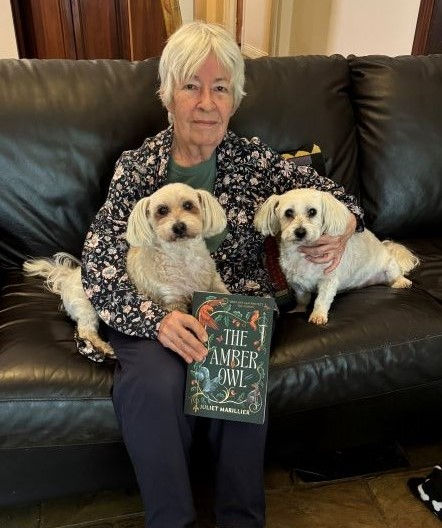
Thank you, Juliet, for your time and your words.
See our review of The Amber Owl below by Lauren Elizabeth Burns
The Amber Owl by Juliet Marillier

Juliet Marillier’s book, The Amber Owl, is an emotional journey through a world rich in nature and quiet resilience. The story follows Stasya, a character deeply aware of the dangers that come with her identity. Stasya guards her trust like a sacred flame. Her path is not one of ease but of honesty and emotional depth. It is through her that we experience a tale both magical and mournful.
The forest in this story isn’t just a backdrop but a character of its own. The book is a heartfelt ode to the natural world, one that invites you to pause and appreciate the quiet wisdom of trees and the sacred bond between all living beings.
The Amber Owl does not shy away from darkness. There is grief and heartbreak, especially through the lens of a magical empath whose deep connection to animals becomes both a blessing and a burden. The emotional weight is real and at times heavy but never without purpose. The tale demonstrates how stories themselves can be a balm for sorrow and a source of strength in the darkest of days.
Some may call this book dark, but dark times are needed in order to know when the light has come. The Amber Owl feels like coming home. You’ll wear a smile on your face while reading, not because everything is easy, but because everything feels true.
~ Lauren Elizabeth Burns


Comments